
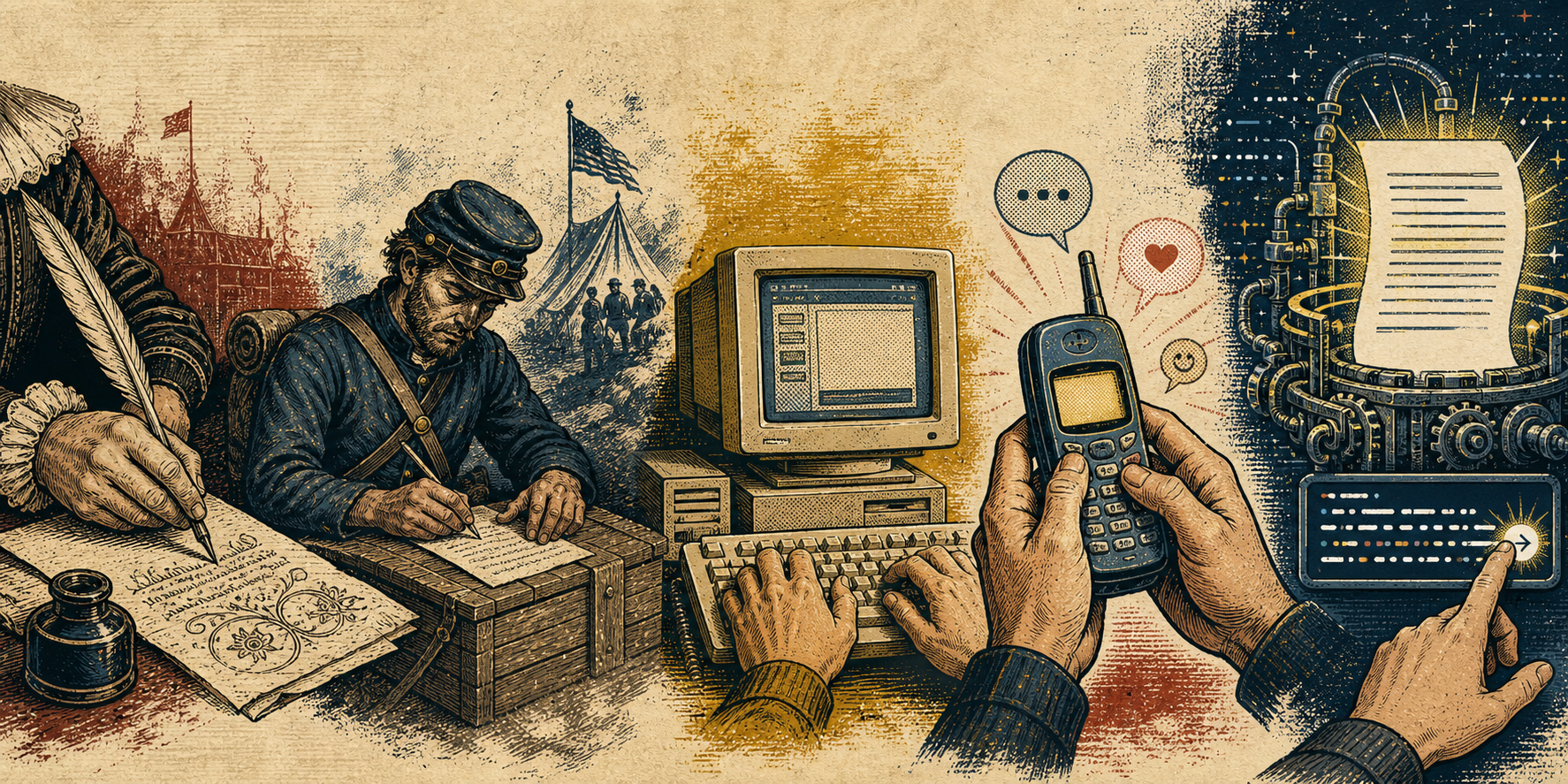
STRATFORD-UPON-AVON / GETTYSBURG / THE PREDICTIVE-TEXT BAR—Humanity progressed from writing sonnets by candlelight to outsourcing “happy birthday” to a language model.
The decline, researchers say, has been underway for at least 400 years and has somehow occurred during the exact period in which more people learned to read, more people learned to write, more words entered circulation, and every emoji could finally reach more readers than Shakespeare ever did.
1599: English reaches its peak before spelling exists
The investigation begins with William Shakespeare, whose English is now treated as the summit of human expression largely because modern readers require footnotes to order the appetizers. His plays gave audiences murder, desire, politics, ghosts, insults, and sentences sturdy enough to survive four centuries of high-school students asking what any of it means.
There is one administrative problem with declaring this the golden age of correct English: spelling in Shakespeare’s time was not fully standardized. Early modern printers, compositors, and writers tolerated variations that would now cause a document to glow with red underlines. Shakespeare’s theater audiences also understood far more than we do. They were paying customers at popular entertainment, not several thousand baffled people politely waiting for Hamlet to become a musical.
“Shakespeare wrote when spelling was flexible, vocabulary was exploding, and nobody had yet been told that ‘wherefore’ means ‘where.’” — Reseda Institute for Confident Historical Claims
1755–1828: Dictionaries arrive to stop everyone from enjoying themselves
Printers had already begun narrowing written conventions after William Caxton brought printing to England in the late 1400s. Then Samuel Johnson’s 1755 dictionary and Noah Webster’s American dictionary of 1828 helped turn common usage into something that could be assigned, tested, and held against a child forever.
Webster helped popularize American forms such as color and center. He also supported experiments including tung, wimmen, and masheen, proving that history’s most successful spelling reformer occasionally wrote like a text message from a lawn mower. Civilization rejected those proposals and continued misspelling tongue in the traditional manner.
1861–1865: Soldiers compose the last known complete sentence
By the Civil War, soldiers were producing letters that can sound astonishingly formal to modern ears. “I embrace the present opportunity to reply” was not unusual machinery for opening a personal note. A writer might then spend six pages describing mud, rations, homesickness, military movements, and the health of every mammal still associated with the family farm.
But the surviving record does not show a nation of perfect grammarians. Original letters contain inconsistent spelling, wandering punctuation, slang, phonetic writing, and sentences that crossed several state lines without encountering a period. Literacy also varied sharply. Some Black soldiers who had escaped slavery dictated letters to officers or chaplains while learning to write for themselves. Their words were not powerful because every comma passed inspection; they were powerful because writing was one of the few ways to cross the distance home.
The chief advantage of the Civil War letter was therefore not superior grammar. It was that paper was scarce, delivery was slow, and nobody could respond with a reaction GIF before the author had finished bleeding on the envelope.
1844–1989: Technology begins charging by the word
The telegraph introduced the first major industrial incentive to get to the point. Companies commonly charged by the word, turning “My beloved, I write to inform you that I shall arrive on Thursday” into “ARRIVE THURSDAY STOP.” Long before a phone offered 160 characters, Victorians had discovered that tenderness becomes expensive after the tenth word.
The typewriter made prose faster and mistakes more official-looking. Email then made delivery nearly instantaneous. Networked email appeared on ARPANET in 1971; within two years it accounted for more than half of that network’s traffic. Humanity had been given a system capable of moving thought across a continent in seconds and immediately used it to circulate jokes, reply to everyone, and ask whether the attachment had come through.
1990–2006: The internet removes adult supervision
Chat rooms, message boards, and instant messaging moved informal language into writing at unprecedented speed. Capital letters became shouting. Repeated punctuation became emotional measurement. “LOL” could indicate laughter, acknowledgment, social discomfort, or that the sender had reached the end of the sentence and found no medically sound exit.
The internet did not invent abbreviation. “OMG” appears in a 1917 letter to Winston Churchill, and the telegraph had been compressing prose for decades before that. What the internet changed was scale: private, speech-like writing became public, searchable, permanent, and available for correction by a stranger whose own post contained three uses of defiantly where definitely was intended.
2007–2022: Thumbs assume editorial control
Early text messaging placed language inside a 160-character container and often behind a numeric keypad. Vowels were declared nonessential personnel. You became u, are became r, and a generation learned to press the 7 key four times to produce an “s,” which qualifies as both writing and low-level safecracking.
Emoji arrived on Japanese mobile phones in 1999 and expanded globally after hundreds were encoded in Unicode in 2010. Punctuation then acquired emotional liability. A period at the end of “okay” no longer meant the sentence was complete; it meant somebody’s mother had retained counsel.
Yet the predicted literacy apocalypse refused to cooperate. Multiple studies found children’s knowledge and use of text-message abbreviations was not associated with worse literacy and sometimes predicted stronger spelling or phonological awareness. To create l8r, it turns out, a child must understand how sounds and letters work. Researchers delivered this finding in standard English, devastating adults who had prepared several paragraphs about discipline.
2023–present: Man who cannot spell “email” promoted to executive editor
Artificial intelligence completes the reversal. The telegraph required a human to remove unnecessary words. Autocorrect repaired individual mistakes. Predictive text offered the next word. Generative AI now offers all the words, correctly spelled and organized into three reassuring paragraphs, before the user has decided what he believes.
The result is the strangest stage in the history of English: public prose may look cleaner while its alleged author becomes less capable of producing the prompt that requested it. A person can enter “wright a proffesional email sayign no,” receive a flawless note about strategic alignment, and leave the transaction convinced he has been writing all afternoon.
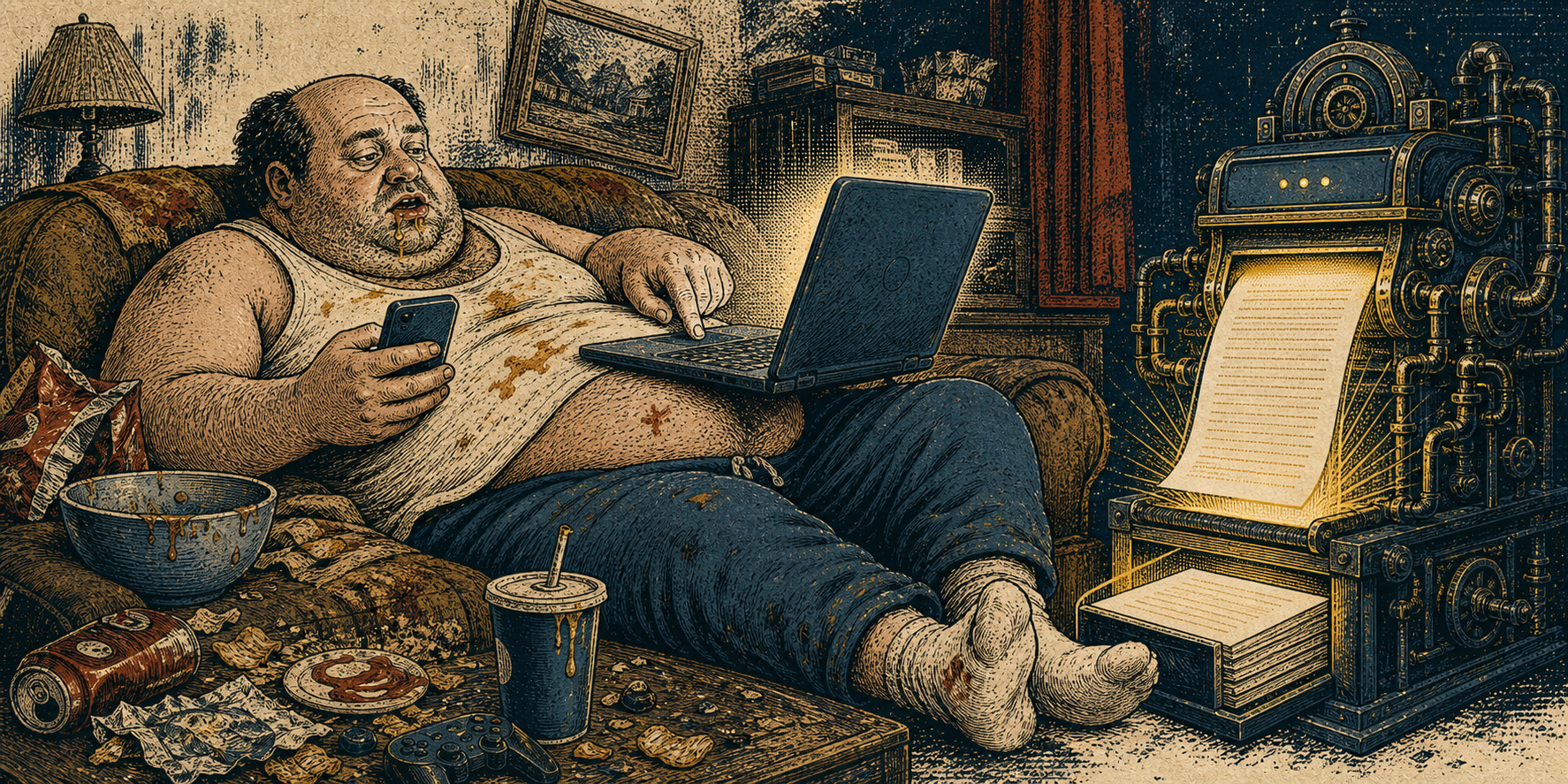
For most of history, bad spelling remained attached to the person who produced it. AI breaks the chain of evidence. The machine quietly accepts whatever has been dragged into the prompt box, launders it through several billion parameters, and returns prose wearing a tie.
Research has not established that AI has made everyone unable to spell. The 2025 knowledge-worker study cited below did not test spelling; it found that generative AI shifted self-reported critical-thinking effort away from carrying out tasks and toward verifying, integrating, and supervising machine output. In other words, the human brain has not been removed from the process. It has been reassigned to management and is currently unavailable for comment.
This is different from the panics over slang, texting, and emoji. To type u, a writer still had to decide he meant you. To send a thumbs-up, he still selected the exact picture most likely to end the conversation. Those systems compressed an intended thought. Generative AI can supply the thought, the vocabulary, the tone, the punctuation, and the tasteful closing while the user contributes “respon to wife she mad.”
English is not becoming less correct on the screen. It is becoming unnaturally correct at the precise moment its operator stops participating. The misspellings have not disappeared; they have moved backstage, where no recipient can see the smoking pile of letters from which a polished quarterly update emerged.
At press time, a man who had not typed a complete sentence since Tuesday rejected three flawless AI drafts because none of them “sounded enough like me.”