
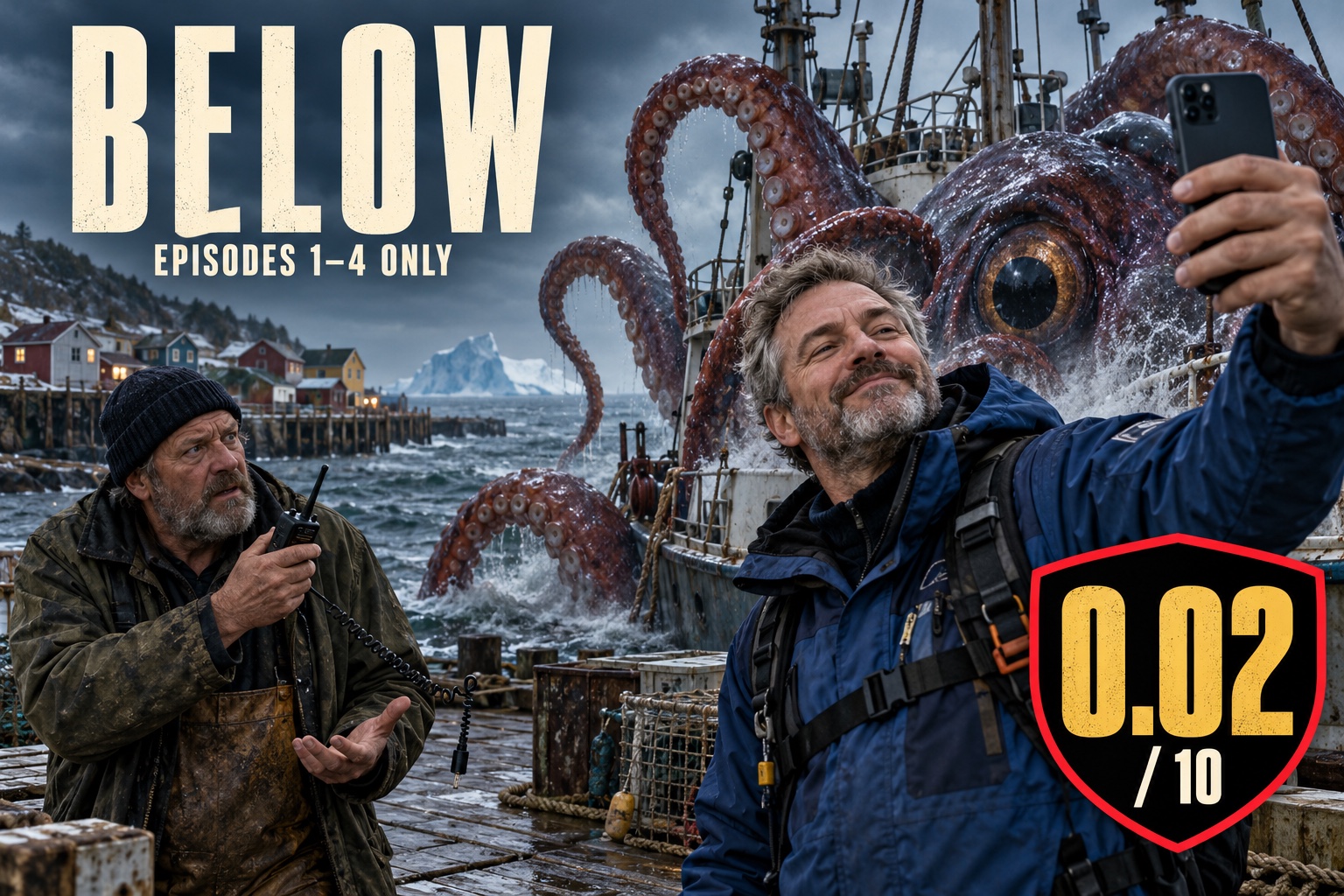
SNOOK'S ARM, NEWFOUNDLAND —In a major breakthrough for monster television, Netflix's Below has discovered a present-day Canadian town capable of producing a giant killer squid, missing people, severed body parts, and a public-health emergency without producing one guy whose first instinct is to put the whole fucking thing on Facebook.
The series is Netflix's second cephalopod hit of the year, following Remarkably Bright Creatures. The first octopus tested so well that the company ordered another eight arms and considerably fewer functioning public services.
For the first four episodes, Snook's Arm remains astonishingly resistant to becoming news. No rolling coverage. No national scramble for interviews. No Instagram account offering a discount code beside a tentacle. In a world where somebody will livestream a dispute over a parking cone, this creature has somehow secured the most comprehensive media blackout in North America.
They have the video. Naturally, this remains a debate.
The show does have cameras and phones. It even has evidence: by episode 2, Calvin and Fonda have watched footage of a tentacled attack involving the missing tourists.
This would normally be the point at which the entire internet arrived, half demanding an evacuation and half announcing that the squid was AI. A man in Ohio would explain why he could beat it. Someone would identify its ex-girlfriend.
Instead, episode 3 supplies a town meeting where the scientist explains the danger and people struggle to believe her. The video has entered the prestigious evidentiary category of Something We Saw Earlier That Must Not Simplify This Scene.
Calvin tries backing her up. An admirable alternative to pressing play.
Canada is available for the buyout.
Government does exist in this universe. There is a resettlement proposal and a payout for leaving town. The machinery required to discuss everyone moving away appears considerably better developed than the machinery required to keep everyone alive until moving day.
By episode 4, the outbreak has produced a makeshift treatment center, with the sick gathered on cots and Fonda trying to keep the situation under control. The outside response has yet to become a functioning part of the rescue. Snook's Arm can get an offer on the whole community; an emergency department remains a more ambitious request.
Snook's Arm has a police officer. Unfortunately, Fonda finds him drinking from a puddle, which limits his ability to establish an incident command center.
There is also an attempt to call the Coast Guard. Ruth makes it while already affected by the outbreak, then has to be pulled away from the water herself. The show has remembered the existence of emergency services while taking considerable precautions against their arrival improving anything.
The marine biologist will see you now.
Fonda is a marine biologist, which makes her the obvious person to investigate an unfamiliar sea creature and a less obvious person to become the community's emergency physician.
She even points out that she is not a medical doctor. The town receives this as a minor administrative discrepancy and proceeds with the appointment.
To her credit, she does more useful work than almost anyone else. That is the problem. A woman whose day job involves marine life has become the outbreak response, patient supervision, and the service that stops people walking into the sea. At this rate, somebody will hand her the school bus keys because fish also travel in groups.
Snook's Arm is small enough to make a hospital seem extravagant, but its disaster management plan still appears to be hoping the woman from the Ocean Science Centre has another free afternoon.
Final Score: 0.02 / 10 — episodes 1–4 only.
Four episodes watched. Further exposure declined.